
Torsion vs Extension Springs: How to Tell Which Your Garage Door Has
Every sectional garage door needs springs to offset its weight. Your opener doesn't really lift the door: the springs do most of the work, and the opener guides it. There are two common spring systems, torsion and extension, and knowing which one you have helps you describe the problem, understand a quote and spot a broken spring from the floor. This post is written for homeowners in Garland, Texas and nearby cities, but the basics apply to most residential doors.
What is the difference between torsion and extension springs?
Torsion springs are mounted on a steel bar (the torsion tube) across the top of the door opening, on the wall just above the header. As the door closes, the springs wind tighter. As it opens, they unwind and turn the bar, which turns cable drums at each end and lifts the door.
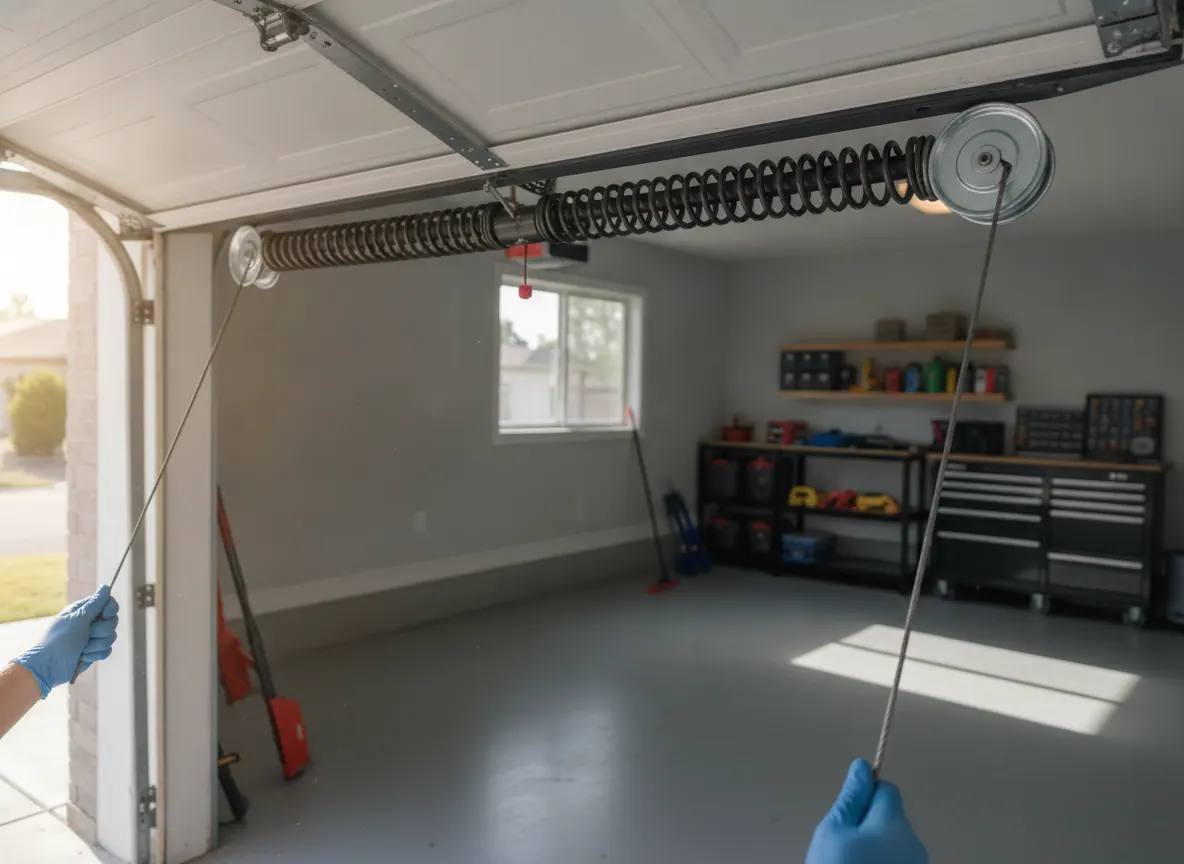
Extension springs run parallel to the horizontal tracks on each side, above the door when it's closed. They stretch as the door closes and contract as it opens, pulling the door up through a set of pulleys and cables. Each one should have a safety cable running through its center to contain it if it breaks.
| Feature | Torsion springs | Extension springs |
|---|---|---|
| Where they sit | On a bar above the door opening | Along the side tracks, above the door |
| How they work | Wind and unwind to turn cable drums | Stretch and contract through pulleys |
| Common on | Many newer and heavier doors | Many older and lighter single doors |
| Typical replacement (Fixr, Jan 2025) | $200–$350 | $120–$250 |
| Rated life (This Old House, Mar 2026) | About 8–15 years, up to 20,000 cycles | About 7–12 years, around 10,000 cycles |
| When one breaks | Visible gap in the coil; door feels very heavy | Spring hangs loose or is stretched out; door may lift crooked |
The cost figures are published national estimates, not quotes. This Old House puts spring replacement overall at $300–$540 (Mar 2026). Garland-area quotes vary.
How to tell which springs your garage door has
You can usually tell from the floor, with the door closed, without touching anything.
Look above the door
Stand inside the garage and look at the wall above the top of the door. A horizontal bar with one or two large coils on it means torsion springs.
Look along the tracks
If the space above the door is empty, look at the horizontal tracks near the ceiling on each side. Long springs stretched beside them, with pulleys at the end, mean extension springs.
Count them
Note whether there's one torsion spring or two. Extension systems use one spring per side. Mention the count when you request quotes.
Older doors in Garland's 1960s and 1970s neighborhoods often have extension springs, while many doors installed more recently use torsion springs, but that's a pattern, not a rule. Doors get replaced, and installers choose systems based on the door's weight, the headroom above the opening and the hardware available. Garland's median home was built in 1978 (American Community Survey 2020–2024), so plenty of houses have had more than one door over the years.
Signs a spring has broken
- A loud bang from the garage, often when nobody is using the door.
- A gap of an inch or two in a torsion spring's coil.
- An extension spring hanging loose, stretched out, or missing from one side.
- The door rises a few inches and stops, or the opener strains and hums.
- The door lifts unevenly or looks crooked in the opening.
- Loose or tangled cables near the bottom corners.
Safety first: Torsion springs store enough energy to cause serious injury. Leave spring and cable work to a trained technician. Extension springs under tension can also cause injuries, which is why the safety cable matters. Don't try to adjust, unwind or remove either type, and stop using the opener once you suspect a broken spring.
Is one type better than the other?
Neither is right for every door. Torsion systems are generally described as smoother and more balanced, and they keep the spring in one place above the door. They also tend to carry longer rated lives in the published guides. Extension systems cost less to replace and fit doors with little headroom. The choice that matters most is that the spring is sized to your door's weight and height. A wrongly sized spring, of either type, can leave the door out of balance and make the opener work harder.
Whatever the type, standard springs are commonly rated around 10,000 cycles, which Fixr says works out to roughly 9 to 10 years at three open-close cycles a day.
Should you convert extension springs to torsion?
Some companies offer to convert an extension system to torsion springs. It can be a reasonable upgrade on a heavier door or one that's out of balance, and it costs more than a like-for-like spring replacement because it means new hardware. It's also a common upsell. Before you agree:
- Ask why the conversion is recommended for your door specifically.
- Ask for a written price for both options: replacing the extension springs and converting.
- Check there's enough headroom above the door for a torsion bar.
- Ask what cycle rating the new springs carry and what warranty terms apply, in writing.
Texas's Deceptive Trade Practices Act prohibits false statements about the need for parts or repairs (Bus. & Com. Code §17.46(b)(13)). Ask for a written estimate and an itemized invoice that lists the parts replaced, and ask for your old parts back. If the work is sold to you at home and goes beyond the repair you called about, read any cancellation notice on the contract before you sign.
What spring replacement typically costs
| Item | Typical range | Source |
|---|---|---|
| Extension spring replacement | $120–$250 | Fixr, Jan 2025 |
| Torsion spring replacement | $200–$350 | Fixr, Jan 2025 |
| Spring replacement (second guide) | $300–$540 | This Old House, Mar 2026 |
| Service call / trip fee | $50–$75 | Fixr, Jan 2025 |
Door size, the number of springs, the cycle rating and the time of day all move the final price. The spring replacement cost guide for Garland breaks those factors down, and the garage door repair cost page has a calculator for other jobs.
Getting quotes
When you request quotes, say which spring type you have, how many, whether the door is single or double, and whether a car is stuck inside. That helps companies give you a closer number. Describe it once on the free quote form or call (877) 265-2390, and independent local garage door companies can reply. The garage door spring repair page explains what a technician typically checks on a spring visit, and the off-track and cable repair page covers cables that come loose when a spring fails.
Frequently asked questions
How do I know if I have torsion or extension springs?
With the door closed, look at the wall above the opening. A bar with large coils on it means torsion springs. If that space is empty and long springs run beside the overhead tracks, you have extension springs.
Are torsion springs more expensive to replace?
Usually. Fixr lists torsion spring replacement at $200–$350 and extension springs at $120–$250 (Jan 2025). These are published national estimates, not quotes, and Garland-area prices vary.
Which type of garage door spring lasts longer?
This Old House gives torsion springs about 8 to 15 years and up to 20,000 cycles, and extension springs about 7 to 12 years at around 10,000 cycles (Mar 2026). Actual life depends on how often the door is used and the spring's rating.
Can I replace an extension spring myself?
It isn't recommended. Both spring types are under tension and can cause serious injury. Leave spring and cable work to a trained technician.