
How Long Do Garage Door Springs Last? Cycle Ratings, Years and Warning Signs
Garage door springs don't wear out on a calendar. They wear out by use. Every time the door opens and closes, the spring flexes once more, and eventually the steel fatigues and breaks. That's why one neighbor's springs last 15 years and another's snap after six.
This guide explains how spring life is measured, how to estimate where your springs are, the signs a spring is near the end, and what that means for homes in Garland, Texas and nearby cities. It doesn't include any spring adjustment or replacement steps. Torsion springs store enough energy to cause serious injury. Leave spring and cable work to a trained technician.
How spring life is measured: cycles
A cycle is one full open and one full close. Standard springs are commonly rated around 10,000 cycles. Fixr says springs "should last at least 10,000 cycles," and notes some extension springs are rated for 20,000. This Old House puts extension springs at about 7 to 12 years (around 10,000 cycles) and torsion springs at about 8 to 15 years (up to 20,000 cycles).
In plain terms: a typical spring lasts about 7 to 14 years of normal use, and a higher-cycle spring can last longer. If you want the difference between the two spring types, see torsion vs extension springs.
How many years is 10,000 cycles?
It depends on how often your household uses the door. Fixr worked through the math for a 10,000-cycle spring:
| Cycles per day | Approximate life of a 10,000-cycle spring |
|---|---|
| 1 a day | About 14 years (This Old House) |
| 2 a day | About 13–14 years |
| 3 a day | About 9–10 years |
| 5 a day | About 5–6 years |
Source: Fixr, January 2025; This Old House, March 2026. Estimates, not guarantees.
A household that uses the garage as the main entrance, with two drivers, a teenager and a few trips to the trash bin, can easily hit five cycles a day. A household that parks in the driveway and uses the garage for storage may run one.
Estimate where your springs are
Count a normal day
Count how many times the door opens and closes on a typical weekday and a typical weekend day, then average them.
Find the spring's age
Check receipts or a sticker on the spring or header if a company left one. If you don't know, assume the springs may be as old as the door.
Do the math
Multiply cycles a day by 365, then by the years since the springs went in. If you're near or past 10,000, the springs are in the range where breaks are common.
This is a planning estimate only. Spring life also depends on how well the spring was sized for the door and on its condition.
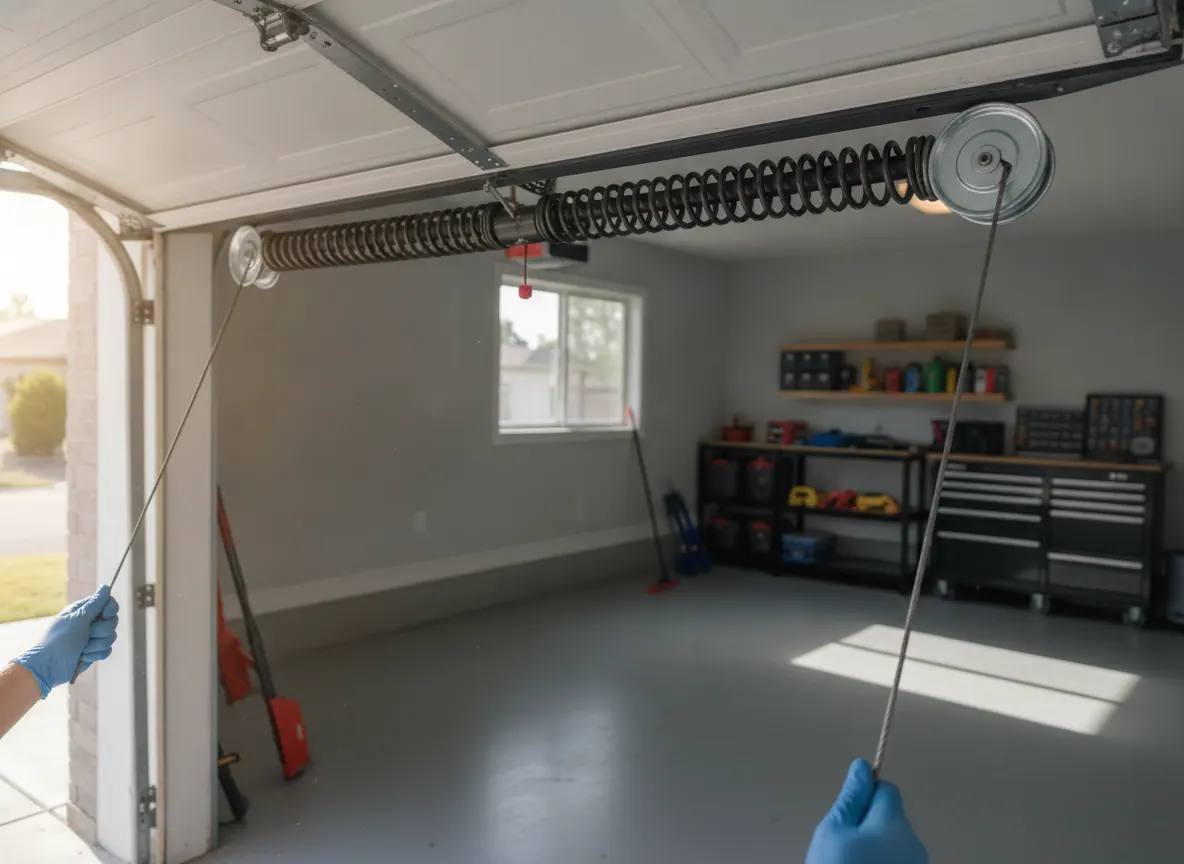
What shortens spring life
- Heavy use. More cycles a day means fewer years, as the table shows.
- A heavier door than the spring was sized for. Adding insulation, a new panel or decorative hardware can change the door's weight.
- Rust. The garage door industry group DASMA says rust "reduces the effective area of spring wire" and that lubrication "will help to maximize spring cycle life."
- A door out of balance. Worn rollers and dry hinges make the whole system work harder. A roller and tune-up visit can catch that early.
- Temperature swings. Garage doors around Garland, TX work through about 106 days a year at 90°F or hotter and about 20 at 100°F or hotter (NOAA 1991–2020 normals, DFW Airport), plus roughly 29 nights at or below freezing. No study we found ties that heat to a specific failure rate, but the door works through it either way.
Signs a spring is near the end
You can check these from the floor without touching anything:
- A visible gap in a torsion spring coil, often after a loud bang from the garage
- Stretched or uneven extension springs along the side tracks
- The door feels heavy, or the opener strains and stops partway up
- The door rises crooked, or one side lifts before the other
- Rust or flaking on the coils
- The door closes hard or slams the last few feet
If a spring has already broken, don't try to lift the door or run the opener over and over. The opener isn't designed to lift the door's full weight. See broken garage door spring repair for what a technician typically does, and emergency garage door repair if a car is stuck inside.
Why Garland homes see so many spring calls
Garland's median home was built in 1978, compared with 1992 for Texas as a whole, and 54.8% of its homes were built before 1980 (American Community Survey 2020–2024). In south and west Garland ZIPs 75041 and 75042, the median build year is 1965 to 1968. Many of those doors have been through several sets of springs, and some may still have older or mismatched springs from past repairs. Newer suburbs like Rowlett, Sachse, Wylie and Murphy are mostly 1990–2019 housing, so many homes there are due for a first or second spring replacement.
Should both springs be replaced at once?
On doors with two springs, many technicians suggest replacing both at the same time. They usually went in together and have about the same number of cycles, so the second one is often close behind. Ask the company to explain its recommendation, and get the price for one spring and for a pair in writing so you can compare.
You can also ask about higher-cycle springs. They usually cost more up front, and This Old House notes torsion springs can be rated up to 20,000 cycles. Whether that's worth it depends on how heavily your household uses the door.
What spring replacement costs
| Item | Typical range | Source |
|---|---|---|
| Spring replacement | extension $120–$250; torsion $200–$350 | Fixr, Jan 2025 |
| Spring replacement (second guide) | $300–$540 | This Old House, Mar 2026 |
| Tune-up | $120–$240 | This Old House, Mar 2026 |
| Service call / trip fee | $50–$75 | Fixr, Jan 2025 |
For more detail, see garage door spring replacement cost in Garland and the full garage door repair cost guide.
When you're ready, request free quotes from independent local companies, or call (877) 265-2390. Ask each one for a written estimate, the trip fee, the spring type and cycle rating, and warranty terms in writing.
Frequently asked questions
How long do garage door springs usually last?
Standard springs are commonly rated around 10,000 cycles, which works out to about 7 to 14 years of typical use. This Old House puts extension springs at about 7 to 12 years and torsion springs at about 8 to 15 years. Heavy daily use shortens that.
What is a garage door spring cycle?
One cycle is one full open and one full close. At three cycles a day, a 10,000-cycle spring lasts roughly 9 to 10 years; at five a day, about 5 to 6 years (Fixr, January 2025).
Can I make my garage door springs last longer?
Keeping the door balanced and the hardware in good shape helps. DASMA notes that rust reduces spring wire and that lubrication helps spring cycle life. A tune-up from a trained technician can catch worn rollers or an out-of-balance door. Don't adjust springs yourself.
Is it normal for one spring to break and the other to keep working?
Yes. On a two-spring door, one usually breaks first. Because both went in at the same time and have about the same cycles, many technicians suggest replacing both. Ask for written prices for one spring and for a pair.